

Delegation from Montenegro Visits China the “Chinese Bridge 2026” Program
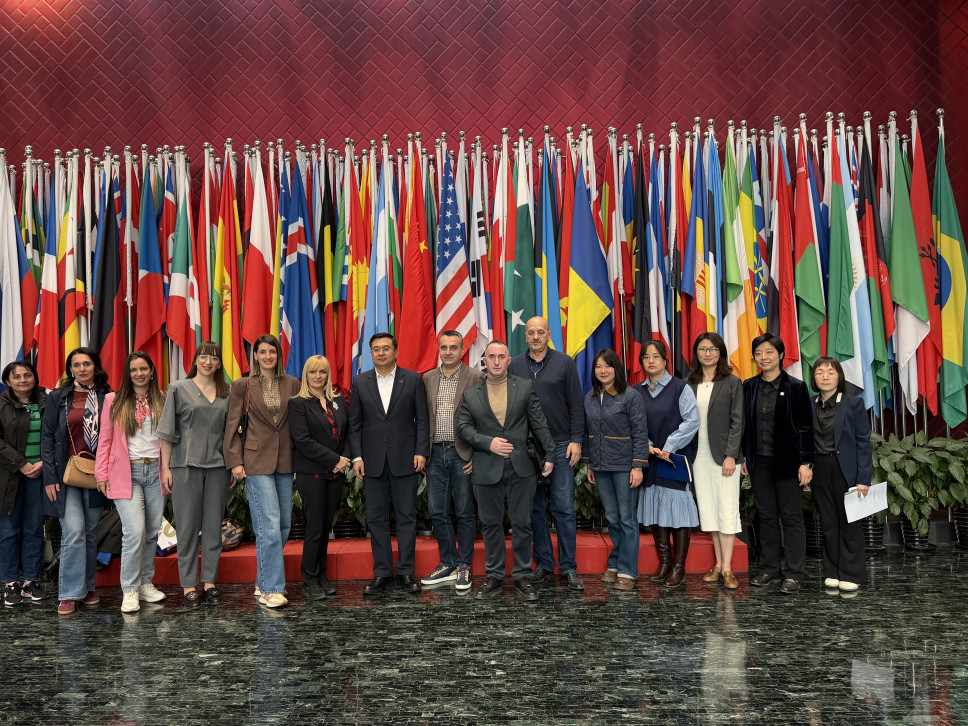
The Confucius Institute at the University of Montenegro, in cooperation with the Center for Language Education and Cooperation and Changsha University of Science and Technology (CSUST), successfully organized an educational and cultural visit of a delegation from Montenegro to China under the title “Chinese Bridge,” held from March 22 to 29, 2026.
The visit was designed as an opportunity for direct engagement with contemporary Chinese approaches to education, international language cooperation, vocational training, and technological development, as well as a platform for further strengthening institutional ties between partners from Montenegro and China. The Center for Language Education and Cooperation operates under the Chinese Ministry of Education and is dedicated to supporting the global teaching of the Chinese language and fostering cooperation in language and culture, while Changsha University of Science and Technology represents a long-standing Chinese partner of the Confucius Institute at the University of Montenegro.
The delegation was led by the directors and the secretary of the Confucius Institute, while the remaining members included representatives of the University of Montenegro, the Capital City, and educational institutions that maintain continuous cooperation with the Institute. During their stay, the delegation visited the Center for Language Education and Cooperation in Beijing, where, together with representatives of the Center and Changsha University, they reviewed previous cooperation results and discussed possibilities for its further enhancement.
The discussions focused on the development of Chinese language teaching, support for mobility programs, professional development of teaching staff, exchange of experiences in educational and cultural cooperation, and further strengthening the role of the Confucius Institute as a platform for academic and intercultural exchange.
On this occasion, the President of the Assembly of the Capital City, Dr. Jelena Borovinić-Bojović, spoke about the cooperation between the Capital City and the Confucius Institute through the organization of various workshops and lectures on Chinese culture. The Vice-Rector for Teaching at the University of Montenegro, Prof. Dr. Veselin Mićanović, addressed the role of the Confucius Institute in promoting Chinese language and culture, as well as the broader academic cooperation between higher education institutions of the two countries. The Director of the Confucius Institute at the University of Montenegro, Assist. Prof. Dr. Milena Lipovina-Božović, highlighted the achievements of the Institute over its ten years of existence and expressed gratitude to Chinese partners for enabling representatives of Montenegrin institutions to gain a closer understanding of China, its traditions, and contemporary trends in educational development for which the country is widely recognized today.
The importance of cooperation between the University of Montenegro and Changsha University of Science and Technology—on which the Institute’s work in Montenegro has been built—was also reaffirmed. The educational dimension of the program was further enriched by a visit to Shanghai, where the delegation toured one of the many Youth Centers in Hongkou District, as well as the Shanghai Nanhu Vocational and Technical College. At the Youth Center, delegation members were introduced to programs encouraging the early development of competencies in robotics, electronics, artificial intelligence, ecology, and related fields. Particularly impressive were the specialized spaces for hands-on learning, innovation, and experimentation, reflecting the strong emphasis of modern Chinese education on interdisciplinarity, research-oriented approaches, and skills development, with special attention given to nurturing talent. During the visit to Nanhu College, a meeting was held with the hosts, during which approaches to high-quality vocational education and various models of digital and smart education in Shanghai were presented.
The delegation subsequently toured several specialized training centers and teaching facilities. This concept of teaching and training demonstrated a high level of alignment between education, technological change, and labor market demands, with a strong emphasis on practical work and the application of modern solutions in the educational process.
In addition to institutional meetings and educational visits, the program also included a rich cultural segment, enabling the delegation to gain a deeper understanding of Chinese history, cultural heritage, and contemporary social development. In Beijing, the delegation visited the Great Wall of China, the Forbidden City, and the Summer Palace—sites that vividly testify to the historical depth of Chinese civilization and its state-building and cultural traditions. In Xi’an, the program continued with a visit to the Terracotta Army and other landmarks reflecting the continuity of Chinese history and its influence on shaping the country’s modern identity. The delegation also visited Shanghai, a city that strikingly combines historical heritage with China’s contemporary urban and technological transformation.
The exchange of ideas and the strengthening of partnerships marked this study visit, confirming that educational cooperation is the best path toward mutual understanding. For participants from Montenegro, it represented a valuable opportunity to gain first-hand insight into Chinese educational practices, institutional cooperation models, and broader social processes, as well as to open new questions and opportunities for future collaboration through dialogue with their hosts.
The Confucius Institute at the University of Montenegro remains committed to its mission of connecting Montenegro and China through language, education, and culture.